
Commercial aviation
The route, the cabin and the airframe: three ways to read the story of passenger flight.
Aircraft are part of a transport system
An airliner has to work with airports, passengers, baggage and schedules. Look at the aircraft’s role before comparing speed or range. A single-aisle jet and a supersonic passenger aircraft answer different questions.
Cabins are choices
A maximum passenger figure is not the seating plan of every airline. Class divisions, exits and service spaces shape the experience. When you compare cabins, retain the aircraft version and the operator’s actual layout.
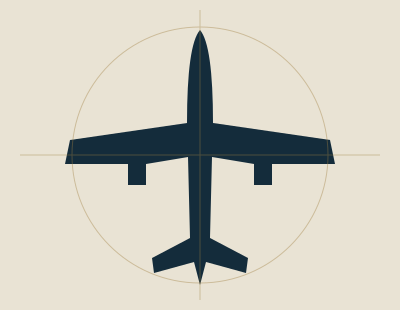
Douglas DC-3
The workhorse behind a different kind of journey.
Explore →Commercial
Boeing 747
The upper-deck silhouette that needs no introduction.
Explore →Commercial
Boeing 737-800
An everyday jet with a very specific identity.
Explore →CommercialAirbus A320neo
Familiar proportions, a new engine generation.
Explore →Commercial
Airbus A350-900
Long-haul design seen through the passenger window.
Explore →Commercial
Concorde, BA passenger configuration
Speed changed the shape of the entire experience.
Explore →Range is not a guaranteed route
Why the biggest number is not always the useful one.
Explore →AirlinesChoosing a scale-model project
Start with the experience you want from the model.
Explore →AirlinesThe North Atlantic as an aviation story
Use one crossing to compare different design priorities.
Explore →